29 Jul 2020

Birding - Not Just a Hobby but a Social Event

  With a lot of the birding slowing down most of my new posts are going to be about some birding insights and personal opinions so prepare to get into the weeds on some of these! Some stuff to expect are bird names, best birding guides, and even clothing to wear birding.  

    To kick off my bout of these new posts let's talk about birding with people. This one isn't weedy at all, trust me when I say I'm easing you in (gotta dip your toe in before you jump in the pool after all) and at some point you'll have to get tick-repellent because we'll be knee deep into the weeds. Be prepared! 
 
     A lot of birders start out by themselves, this is a fact that can't be denied. Yet, as you get older, you find people to bird with even though you're busier now than you have ever been. Be it juggling work, kids, and the gloom of responsibility. So how is it birders tend to stick together rather than soar apart much like the Albatross we all would like to find? 

     Just like Cedar Waxwings, people are social. They need the company of others to really feel at home doing something they love. This is what drives us all to find the people you want to bird with and be around, and it can be the most fulfilling part of birding. There is nothing like celebrating a lifer with a friend around. 

    I have only immersed myself into this type of birding for about a year and even more in the last few months (after COVID-19 restrictions relaxing). In fact you may notice some of my more common guests on the blog Liam Thorne, Laurie Stacey, and Colleen Reilly (you'll be hearing a lot more about these people and more depending on when things are going to go back to normal). Yet, for some reason, I feel the need to get into why I've been doing that. Well, that is the part of birding people (myself included) often overlook, the social side. This is the pinnacle of some peoples' experiences, and sightings. Not only did you get that new bird or see that new behaviour but you were able to witness it with someone who may have never seen that either. No feeling is better than turning around and giving/getting the hugest high five and seeing the excitement in someone's face. This is what has pushed me to get into birding together more. 
    I have led a quite a few walks myself around Haldimand-Norfolk, mostly in Ruthven and Selkirk, and nothing has paralleled the feeling of being there for someone finding their first ever bird of a single species, even seeing one for myself. I have obviously experienced a lot of life birds, both alone and with someone else, and to see a life bird with someone else is a feeling you'll never shake, and any life bird you find alone after, just doesn't feel the same. 

    My own opinion on this matter is displayed above by far. Friends make our experience much better, and it's a story you'll be telling for a long time after. This is what makes those experiences priceless, this is my opinion of what prime birding is like, it might not be everyone's, but it is by far mine. 

    Please stay safe, social distance, and most of all try to bird with others, everyone. I Couldn't have made a better decision in my own birding! 

Male Cedar Waxwing - Norfolk ON 

27 Jul 2020

Wasaga, Carden, and some of the best photography I have ever done. (10-Jul-2020)

    I took the day off to do a trip to see one of the most endangered species in the whole province... Piping Plover. Inland these are some of the most difficult shorebirds to find as their plumage is sandy coloured and they're insanely fast. They have been found breeding on Beach 1 in Wasaga Beach Provincial Park, that was my first stop. 

    I left my place pretty early, around 5 am. I wanted to miss traffic in Barrie. When I got to the park it was completely empty, 8 am on a Friday, pretty believable. I step out and immediately I can see the light coloured sand and my first ever glimpse of Lake Huron (making this the 3rd Great Lake I have ever birded on). I could hear Ring-billed Gull and Song Sparrow calling towards the beach and an American Robin bouncing around in the parking lot. I walked towards the beach and I seen a quick little scuttle towards the beach, oh my god! Piping Plover! I had only been here for 5 minutes. This was amazing. 

    After 1 plover showed itself, it turned into 5, then 7, then 9... the plover were everywhere and I was soaking up every second of it! After walking down the boardwalk a little further I decided to turn back towards the car, since Wasaga really isn't that far north I wasn't expecting many different birds than I got at home, and I didn't get any but the plover. 
    The way back was pretty much the same, plovers to the left, American Robin calling to the right. Astonishing to see so many of an endangered species in a single area. Once I got back to the end of the boardwalk I noticed how close the plovers were coming. So walking right under the walkway. So, I decided to take my camera and sit in the sand to see how the plovers would act. Surprisingly, they weren't phased at all by my actions. They kept walking around and one even got only a couple feet from my legs. This is an experience no birder could ever forget. 

    Once I left Wasaga I took a trip to Tiny Marsh Provincial Wildlife Area, only 30 mins away. With it being so hot and seemingly packed with passerines I decided to leave my scope in the car and just bring my camera and bins. 
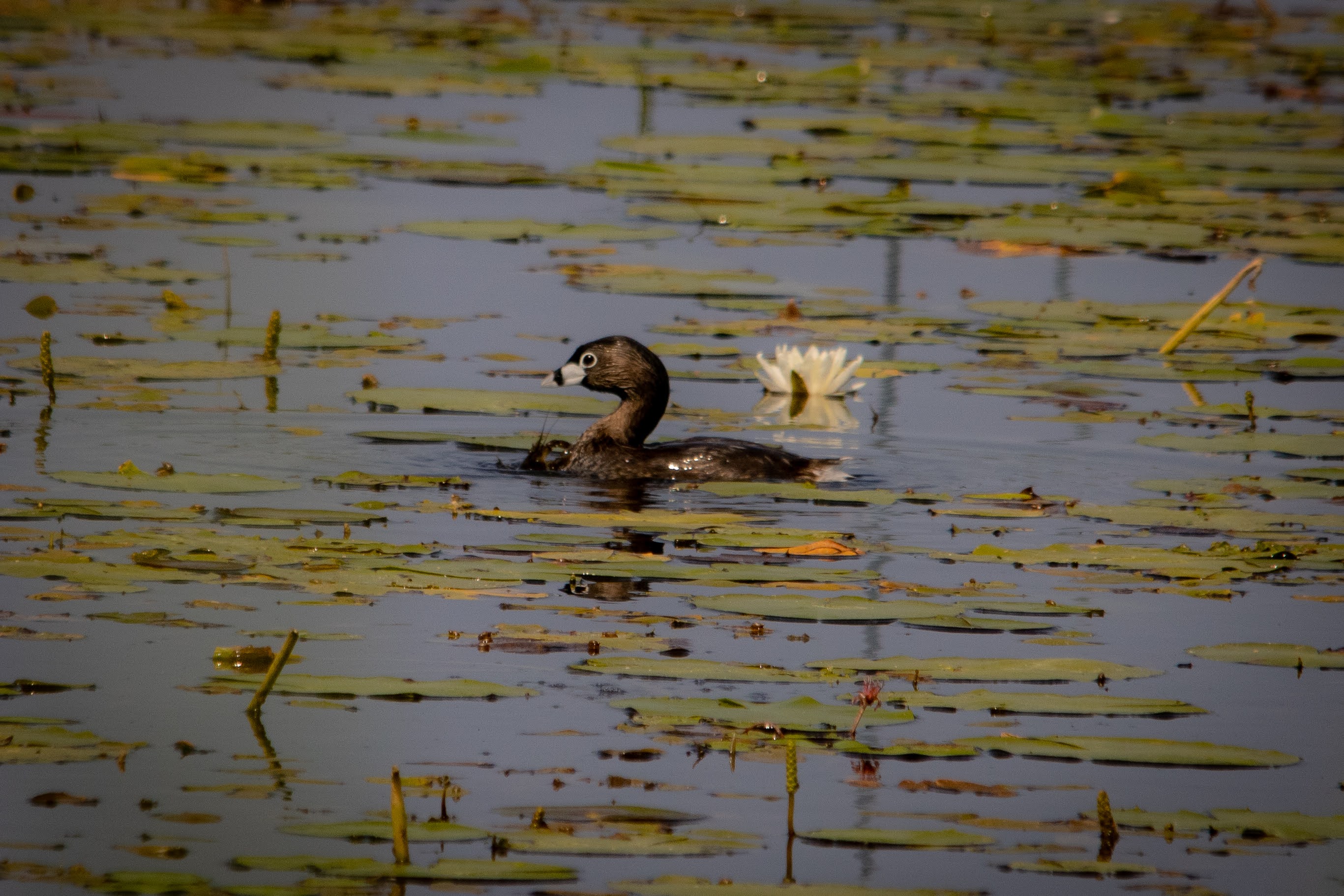
    The park was completely empty. No one walking around which always makes birding easier, no one to scare the birds away. I walked for only a few seconds when I heard a bird that calls loudly in the migration period at home, fee-a-bee an Eastern Phoebe called and not 5 seconds later landed on a platform in front of me. After snapping a couple of pictures I headed towards the marsh walk. Another Phoebe called and Red-eyed Vireo calling from the woods above. The Phoebe is joined by a Least Flycatcher calling from a little ways away. I kept walking and hearing more birds like Song Sparrow and American Redstart. Walking towards the marsh I seen a quick flash from across the canal, Northern Waterthrush! Then to the left of me were two Brown Creeper! A rare view in the middle of summer. The birds are just buzzing here and I added Sandhill Crane and Swamp Sparrow to my ever growing list. The trip in Tiny was pretty uneventful until I got back and headed to an opening. I was looking for marsh birds like rails or gallinule which somehow I had missed on the lookout. I walked up the lane-way and seen another Sandhill Crane flyover, I looked for it but it had already landed in the cattails. Then a chatter call from the reeds to my left, Common Gallinule! I knew that call very well with the ones I have heard in Big Creek! Then on the way back a Pied-billed Grebe! Phenomenal, these small pigeon-billed grebes are not very common in my neck of the woods this time of year so after a couple pictures I headed back to my car, feeling pretty good about my decision to come here. Now, next stop, Carden Alvar. 

    When I got to Carden I didn't know what to expect, but I knew it wasn't what I got. It looked like a barren wasteland. It honestly reminded me of central Alberta, very open and grassy. This was a surprise for central Ontario, but a pleasant surprise at that. 
    Immediately after getting out of the car I heard a familiar call, probably one of the weirdest ones coming from one of the weirdest birds we have here. Upland Sandpiper. I know they're quite common around here but from my impression they were also quite far away, this one sounded close. I look to my left and there it was, 20 feet from me sitting on a fence post. Calling loudly I quickly slung my camera up and snapped some photos. These are the closest and best photos I have ever taken of an Upland and I can imagine it will remain that way for a quite a while. Moving on after hearing 2 more around I kept hearing the calls of a small buzzy sparrow that I have been hearing and seeing everywhere somehow. Grasshopper Sparrow. I have never taken photos of one since I've always just heard them calling but I was dead set on today being the day I grab some photos of this amazing little bird. After what seemed like forever searching for the little guy I found it at the top of a small pine. I snapped a couple pictures, this marked my last moment here. I could not stand the heat anymore, sweat pouring down my face and my heart pounding in my chest, it's time to go home. 

    All in all my day in Central Ontario was a huge success. Loved the birds I seen and the places I seen were all places I hope to visit again sometime! I do recommend going to Carden a little earlier than I did though! 

This young male American Redstart was having a pretty bad hair day as he molts out of his old baby feathers into his big-boy feathers. - Simcoe County ON
Pied-billed Grebe are small hard to find birds with short pigeon-like bills with dark stripe through the middle of it. - Simcoe County, ON
Upland Sandpipers are hard to find grassland birds that breed in southern and central Ontario. They are wonky looking and quite large standing at almost a foot in length. - Kawartha Lakes, ON
These dark medium-sized flycatchers are a common sight to Ontario birders and I have found them breeding anywhere from Long Point to North Bay - Simcoe County, ON
After some determination I finally found this Grasshopper Sparrow whose song is often mistaken for an insect rather than a bird, just like chipmunks sounding similar to both Cardinal and Cuckoos. - Kawartha Lakes, ON
This picture of an Upland Sandpiper really shows its irregularity, a plump body, small head, thin bill, and long knobby-kneed legs. - Kawartha Lakes, ON
The colour Bands on these Piping Plover are unique to each bird and are never repeated. - Simcoe County ON
This Piping Plover chick was just one of the 2 that showed up while I was there and they were the cutest and fastest little birds I have ever witnessed - Simcoe County, ON
I got so close to this Piping Plover my heart was pounding and I could almost hear the sand being kicked up from underneath its feet. - Simcoe County, ON

24 Jul 2020

Feeding Swarms and Grebes (5-Jul-2020)

    Bronte Heritage Park, the location for a bird that I've been wanting to see for a quite a while. Red-necked Grebe. They breed along the north shore of Lake Ontario and are quite easy to find according to a lot of people, I haven't gone out for one yet though. 

    Liam was also missing one for his year list so we both came out to find it. We met up at the park and heading the direction that we were told the bird was in. The walk over was pretty typical for the shoreline of Lake Ontario and seen a lot of Common Tern and Ring-billed Gull.
    It was odd birding in such a urban area for the most part this summer has been filled with socially distant and places normal people would thing a body would be ditched or is kinda crappy (little Sewage Lagoon pun, sorry had to). It was an easy walk at least, better than walking on the iffy rocks at Townsend for sure. 

    At the building we hung a right and headed out towards the marina. That would be our best bet to see these water-dwellers. On the way there we hear a nasally awkward call that Liam and I both knew immediately. Fish Crow. They frequent the harbour and are not too difficult of a bird to find in the area. We spotted one eating out of a trash can, it was hard to miss since it was calling and eating. I raised my camera and snapped some pics just to say I've gotten some of a for sure Fish Crow and not get asked if it wasn't just a smaller American Crow. 

    We continued down the path and decided to stop and admire some of the Terns flying around. Caspian and Common all of them. The Commons are so much smaller than the Caspian and I knew that you just can't see the reality of that until you see the 2 of them interacting with each other. We seen a huge black spot in the middle of the lake about 300m away. Scoping up we notice that it is a huge flock of Double-crested Cormorant! They're in a feeding swarm which means lots of fish. The average Double-crested can down a pound of fish every day. That's a lot of fish when you add up how many of these birds there are. With the list of their natural predators being as low as it is we will continue to see an increase of these birds. This in turn will have some negative effects on the biodiversity of our waterways, but I can get into this in a whole other post! 

    Passing by the cormorants there were lots of swallows (we counted 5 species) all flying around us, luckily not dive bombing as I have found that swallows can be viewed as some of the most aggressive species around. Getting out to the end of the pier was pretty easy, not too hot out yet and our eyes were focused on seeing some Grebes. It seems like we waited forever for them. We talked about other stuff going on in our shared world but still nothing. Talk, look for a Grebe, talk, look for a Grebe. It probably felt a lot like a lot longer than it was... we tend to be an impatient pair. 
    We started spit-balling new places to go, the longer the wait the more we convinced ourselves to move on. Just as we were about to move onto another spot Liam's face broke into a smile and said "Grebe!" I swung around and there it was, magnificent. Full breeding plumage, just floating by. Nothing even phasing it, even a kayaker who got about 2 feet from the bird, didn't even flinch. I have never seen a species of water-dwelling bird so calm before. It was an experience I will never forget! 

This is a perfect comparison of the Caspian and Common Terns. To put this in a little perspective, the Common Tern preening in the front is actually a couple feet closer to me than the Caspian, yet the Caspian is still much larger! 
This Fish Crow was feeding on some "tasty" garbage. This really shows the unfortunate reality that is humanity, most of the stuff there is 100% recyclable.. 
That reddish neck is what gives the Red-necked Grebe it's name but the striking yellow bill and beautiful facial pattern is what takes my breath every single time I see one. 
This picture really shows what a bird nose looks like, it is a hole in their bills that will go straight through and you can see it clearly here as the "white spot" on this individual.