Showing posts with label Birding. Show all posts

21 Sept 2020

The hardest birds to ID - Gulls

 Everyone discredits gulls. They're "boring" and most of the time aren't considered "good" birds. I however believe gulls to not only be one of the best adapted (specifically Ring-billed there) but some of the most interesting ID problems in the birding world. 

    Why do I think that? You may ask, with Empidonax flycatchers, peep sandpipers, and ever so difficult Mallard-like-ducks existing what makes gulls my nemesis for ID? To that, I have two words for you; prolonged ageing. Certain species of gull can go through 4-5 different plumage variations in their lifetime, and the majority going through at least 3-4. And these are only standard plumages let alone worn or "bleached" birds. 

    Have I lost you yet with the jargon on gulls? Let's start out with the basics. Let's use Ring-billed Gulls as an example. All gulls have young, juvenile, immature, and adult plumages. Ringers have 8 different plumage types; Juvenile, 1st Winter, 2nd Summer, 2nd Winter, 3rd Winter, 3rd Summer, adult basic, and adult alternate. Not to mention albinism or partially leucistic plumage. That is a lot of plumage variations to remember... so you can see why even the most experienced birders still get confused with gulls. Compared to fall warblers who have 3-4 different plumage types (typically, male, male basic, female, and first-winter male), gulls can be overwhelming. So here are a few ways I find works for gulls:

  1. Always have a guide/ID app on you
    • now, this maybe isn't a new thing for birders, especially new ones. This is the easiest way to find solace in the struggle of identification. This is especially key, I find, with gulls. The plumage variation can make any person question their sighting, so keep that guide by your side! 
  2. Make sure you have more than 1 positive ID feature in view
    • this is one that most veteran birders are very familiar with. Birds are not always so easy as an American Robin or Wood Duck. These birds are obvious birds to ID but once you get into more difficult or rare birds it's good to get a 100% look at a bird if possible. If you don't then you can't call it anything but gull sp.  
  3. Ask for an outside opinion
    • this is what I find to be most effective if you can't figure it out. There will always be someone who might know better than you, so why not take a chance? Maybe you missed something, maybe you just can't get a good stick and you're jumping to rarity, whatever it is, outside help will always have better results than killing yourself over it. 
  4. Take PHOTOs 
    • I know there are birders who don't like cameras, I get it, photographers can be relentless to get that "perfect shot" but it can also help with those tricky IDs. Photographing a bird has gotten me out of a bind a few times, and they're the best photographs you'll ever take. Taking a photo also gives you the opportunity to look back at that picture and be like, you know, I think that's this not that. 
Hope these little tips (even though pretty straight forward) are helpful. They seem to be effective for gulls for me. And don't forget to get this great guide for a more in-depth look at gulls and terns. 

Gulling out of here and terning the page on this topic! 

Good birding guys and girls! 

Adult Herring Gull sitting in the waters of Lake Erie - Haldimand ON
This Ringer is enjoying the sand between its toes - Haldimand ON
Juvenile Common Tern catching some fish at the local pier - Haldimand ON
Found a banded Juv. Herring Gull - turns out it was banded in Ohio and made the trip over to Ontario - Haldimand ON


This month has been shorbly one of my favourite this year.

     August has been a whole different ball game for me. The birds haven't been the typical passerines I usually target. Shorebirds have been on my mind since late July. This has torn me away from my typical birding places like Selkirk Prov Park and Rock Point Prov Park and pulled me to places like Windermere Basin Park and Townsend Sewage Lagoons. This has been nothing short of exciting, bosting some of my favourite birds of the year and an exciting lifer. 

   August also saw me go to 2 new counties in Ontario (Perth and Huron)! To top it off I met Ken Burrell (the leader of the trip). We went to 3 lagoons and saw some really great birds! 
The first lagoon was Milverton. That lagoon was packed with Lesser Yellowlegs! 189 individuals in a single cell! Tucked in with them was a Wilson Snipe, plenty of Pectoral Sandpiper and an early Dunlin!! This was peak shorebirding! 
After moving on from Milverton we went to the West Perth Wetland or the Mitchell Sewage Lagoons. These lagoons were less filled with shorebirds but still gave us all some great looks at Green-winged Teal. The only shorebirds we managed to find were a pair of Wilson Snipe and a beautiful Solitary Sandpiper! Nonetheless, this was still a really nice spot for rounding out the waterfowl we missed at Milverton. 
Finally, we ended up in Huron County at the Exeter Sewage Lagoons. This was a great spot and brought my second Marbled Godwit of year following the one I found at the Wainfleet Wetlands! Yet again Lesser Yellowlegs reined supreme with a count of 101 individuals! The more we looked the more birds we found. This included a Black-bellied Plover, a few Stilt Sandpier and a Baird Sandpiper! 
After we left the lagoons Liam and I decided to chase down a local sighting of a Buff-breasted Sandpiper near Unity Rd in Caledonia. After searching for what seemed like an hour in the blistering heat, we looked over in the shade behind a house and saw a small sandy coloured spec in the field. That was it! After snapping some really bad pictures of the bird he and I both decided it was time to call it a day, and what a day it was! 

At then end of the day I accumulated 53 species and 16 species of Shorebird! Among these shorebirds I found my 228th and 229th bird species of the year (Baird Sandpiper and Buff-breasted Sandpiper)! 

Here are the species I got new for the year in August (bolded birds were lifers for me):

223: Pectoral Sandpiper 
224: Black-bellied Plover
225: Sanderling
226: Willet
227: Red Knot
228: Baird Sandpiper
229: Buff-breasted Sandpiper
230: Black Scoter
231: Purple Finch
232: Long-tailed Jaeger
This is one of the largest shorebirds in Eastern North America: Willet - Turkey Point, ON
This is one of the larger of the peeps - Pectoral Sandpiper, IDed by its bicoloured bill and bold brown bib - Perth County, ON
This is one bird I always love seeing - Wilson Snipe - Perth County, ON
Solitary Sandpiper - these stary-backed shorebirds are always a treat - Perth County, ON
These large Stilt Sandpiper are often mistake for Lesser Yellowlegs but their bright white supercillium and brown overall colour draw them out of the crowd - Huron County ON
Yet another Marbled Godwit! Absolutely stunning, not to mention HUGE - Huron County, ON
This is a juvenile Red Knot, it doesn't shore the gorgeous colour of the breeding plumage adults unfortunately! - Norfolk County, ON

My first Sanderling of the year was an absolute stunner and is the closest I've ever been to these pretty little birds! - Haldimand County, ON
Black-bellied Plover are the largest plover on this side of North America at a whopping 11.5"! Love seeing these guys come through in the fall! - Niagara County, ON

29 Jul 2020

Birding - Not Just a Hobby but a Social Event

  With a lot of the birding slowing down most of my new posts are going to be about some birding insights and personal opinions so prepare to get into the weeds on some of these! Some stuff to expect are bird names, best birding guides, and even clothing to wear birding.  

    To kick off my bout of these new posts let's talk about birding with people. This one isn't weedy at all, trust me when I say I'm easing you in (gotta dip your toe in before you jump in the pool after all) and at some point you'll have to get tick-repellent because we'll be knee deep into the weeds. Be prepared! 
 
     A lot of birders start out by themselves, this is a fact that can't be denied. Yet, as you get older, you find people to bird with even though you're busier now than you have ever been. Be it juggling work, kids, and the gloom of responsibility. So how is it birders tend to stick together rather than soar apart much like the Albatross we all would like to find? 

     Just like Cedar Waxwings, people are social. They need the company of others to really feel at home doing something they love. This is what drives us all to find the people you want to bird with and be around, and it can be the most fulfilling part of birding. There is nothing like celebrating a lifer with a friend around. 

    I have only immersed myself into this type of birding for about a year and even more in the last few months (after COVID-19 restrictions relaxing). In fact you may notice some of my more common guests on the blog Liam Thorne, Laurie Stacey, and Colleen Reilly (you'll be hearing a lot more about these people and more depending on when things are going to go back to normal). Yet, for some reason, I feel the need to get into why I've been doing that. Well, that is the part of birding people (myself included) often overlook, the social side. This is the pinnacle of some peoples' experiences, and sightings. Not only did you get that new bird or see that new behaviour but you were able to witness it with someone who may have never seen that either. No feeling is better than turning around and giving/getting the hugest high five and seeing the excitement in someone's face. This is what has pushed me to get into birding together more. 
    I have led a quite a few walks myself around Haldimand-Norfolk, mostly in Ruthven and Selkirk, and nothing has paralleled the feeling of being there for someone finding their first ever bird of a single species, even seeing one for myself. I have obviously experienced a lot of life birds, both alone and with someone else, and to see a life bird with someone else is a feeling you'll never shake, and any life bird you find alone after, just doesn't feel the same. 

    My own opinion on this matter is displayed above by far. Friends make our experience much better, and it's a story you'll be telling for a long time after. This is what makes those experiences priceless, this is my opinion of what prime birding is like, it might not be everyone's, but it is by far mine. 

    Please stay safe, social distance, and most of all try to bird with others, everyone. I Couldn't have made a better decision in my own birding! 

Male Cedar Waxwing - Norfolk ON 

27 Jul 2020

Wasaga, Carden, and some of the best photography I have ever done. (10-Jul-2020)

    I took the day off to do a trip to see one of the most endangered species in the whole province... Piping Plover. Inland these are some of the most difficult shorebirds to find as their plumage is sandy coloured and they're insanely fast. They have been found breeding on Beach 1 in Wasaga Beach Provincial Park, that was my first stop. 

    I left my place pretty early, around 5 am. I wanted to miss traffic in Barrie. When I got to the park it was completely empty, 8 am on a Friday, pretty believable. I step out and immediately I can see the light coloured sand and my first ever glimpse of Lake Huron (making this the 3rd Great Lake I have ever birded on). I could hear Ring-billed Gull and Song Sparrow calling towards the beach and an American Robin bouncing around in the parking lot. I walked towards the beach and I seen a quick little scuttle towards the beach, oh my god! Piping Plover! I had only been here for 5 minutes. This was amazing. 

    After 1 plover showed itself, it turned into 5, then 7, then 9... the plover were everywhere and I was soaking up every second of it! After walking down the boardwalk a little further I decided to turn back towards the car, since Wasaga really isn't that far north I wasn't expecting many different birds than I got at home, and I didn't get any but the plover. 
    The way back was pretty much the same, plovers to the left, American Robin calling to the right. Astonishing to see so many of an endangered species in a single area. Once I got back to the end of the boardwalk I noticed how close the plovers were coming. So walking right under the walkway. So, I decided to take my camera and sit in the sand to see how the plovers would act. Surprisingly, they weren't phased at all by my actions. They kept walking around and one even got only a couple feet from my legs. This is an experience no birder could ever forget. 

    Once I left Wasaga I took a trip to Tiny Marsh Provincial Wildlife Area, only 30 mins away. With it being so hot and seemingly packed with passerines I decided to leave my scope in the car and just bring my camera and bins. 
    The park was completely empty. No one walking around which always makes birding easier, no one to scare the birds away. I walked for only a few seconds when I heard a bird that calls loudly in the migration period at home, fee-a-bee an Eastern Phoebe called and not 5 seconds later landed on a platform in front of me. After snapping a couple of pictures I headed towards the marsh walk. Another Phoebe called and Red-eyed Vireo calling from the woods above. The Phoebe is joined by a Least Flycatcher calling from a little ways away. I kept walking and hearing more birds like Song Sparrow and American Redstart. Walking towards the marsh I seen a quick flash from across the canal, Northern Waterthrush! Then to the left of me were two Brown Creeper! A rare view in the middle of summer. The birds are just buzzing here and I added Sandhill Crane and Swamp Sparrow to my ever growing list. The trip in Tiny was pretty uneventful until I got back and headed to an opening. I was looking for marsh birds like rails or gallinule which somehow I had missed on the lookout. I walked up the lane-way and seen another Sandhill Crane flyover, I looked for it but it had already landed in the cattails. Then a chatter call from the reeds to my left, Common Gallinule! I knew that call very well with the ones I have heard in Big Creek! Then on the way back a Pied-billed Grebe! Phenomenal, these small pigeon-billed grebes are not very common in my neck of the woods this time of year so after a couple pictures I headed back to my car, feeling pretty good about my decision to come here. Now, next stop, Carden Alvar. 

    When I got to Carden I didn't know what to expect, but I knew it wasn't what I got. It looked like a barren wasteland. It honestly reminded me of central Alberta, very open and grassy. This was a surprise for central Ontario, but a pleasant surprise at that. 
    Immediately after getting out of the car I heard a familiar call, probably one of the weirdest ones coming from one of the weirdest birds we have here. Upland Sandpiper. I know they're quite common around here but from my impression they were also quite far away, this one sounded close. I look to my left and there it was, 20 feet from me sitting on a fence post. Calling loudly I quickly slung my camera up and snapped some photos. These are the closest and best photos I have ever taken of an Upland and I can imagine it will remain that way for a quite a while. Moving on after hearing 2 more around I kept hearing the calls of a small buzzy sparrow that I have been hearing and seeing everywhere somehow. Grasshopper Sparrow. I have never taken photos of one since I've always just heard them calling but I was dead set on today being the day I grab some photos of this amazing little bird. After what seemed like forever searching for the little guy I found it at the top of a small pine. I snapped a couple pictures, this marked my last moment here. I could not stand the heat anymore, sweat pouring down my face and my heart pounding in my chest, it's time to go home. 

    All in all my day in Central Ontario was a huge success. Loved the birds I seen and the places I seen were all places I hope to visit again sometime! I do recommend going to Carden a little earlier than I did though! 

This young male American Redstart was having a pretty bad hair day as he molts out of his old baby feathers into his big-boy feathers. - Simcoe County ON
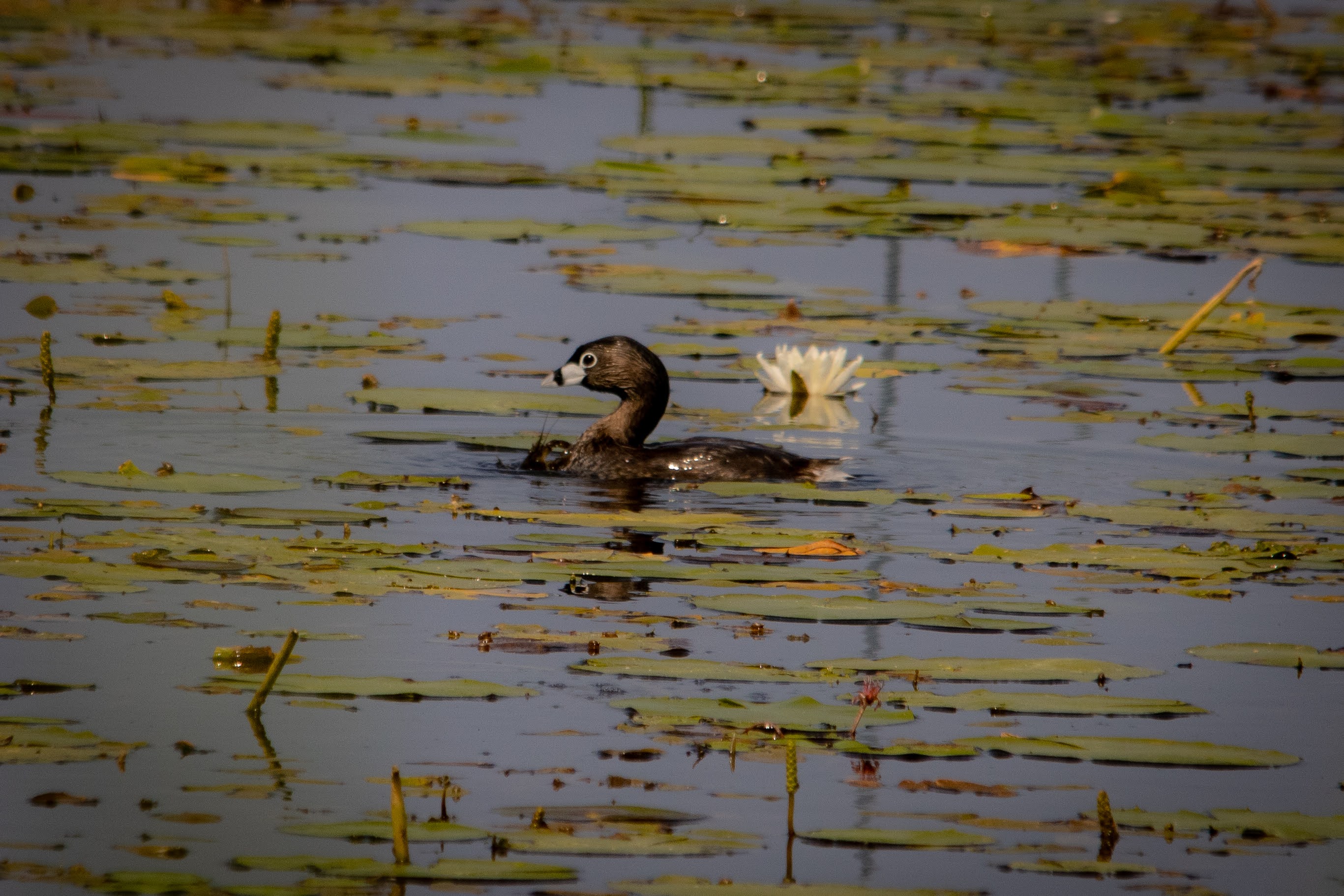
Pied-billed Grebe are small hard to find birds with short pigeon-like bills with dark stripe through the middle of it. - Simcoe County, ON
Upland Sandpipers are hard to find grassland birds that breed in southern and central Ontario. They are wonky looking and quite large standing at almost a foot in length. - Kawartha Lakes, ON
These dark medium-sized flycatchers are a common sight to Ontario birders and I have found them breeding anywhere from Long Point to North Bay - Simcoe County, ON
After some determination I finally found this Grasshopper Sparrow whose song is often mistaken for an insect rather than a bird, just like chipmunks sounding similar to both Cardinal and Cuckoos. - Kawartha Lakes, ON
This picture of an Upland Sandpiper really shows its irregularity, a plump body, small head, thin bill, and long knobby-kneed legs. - Kawartha Lakes, ON
The colour Bands on these Piping Plover are unique to each bird and are never repeated. - Simcoe County ON
This Piping Plover chick was just one of the 2 that showed up while I was there and they were the cutest and fastest little birds I have ever witnessed - Simcoe County, ON
I got so close to this Piping Plover my heart was pounding and I could almost hear the sand being kicked up from underneath its feet. - Simcoe County, ON

24 Jul 2020

Feeding Swarms and Grebes (5-Jul-2020)

    Bronte Heritage Park, the location for a bird that I've been wanting to see for a quite a while. Red-necked Grebe. They breed along the north shore of Lake Ontario and are quite easy to find according to a lot of people, I haven't gone out for one yet though. 

    Liam was also missing one for his year list so we both came out to find it. We met up at the park and heading the direction that we were told the bird was in. The walk over was pretty typical for the shoreline of Lake Ontario and seen a lot of Common Tern and Ring-billed Gull.
    It was odd birding in such a urban area for the most part this summer has been filled with socially distant and places normal people would thing a body would be ditched or is kinda crappy (little Sewage Lagoon pun, sorry had to). It was an easy walk at least, better than walking on the iffy rocks at Townsend for sure. 

    At the building we hung a right and headed out towards the marina. That would be our best bet to see these water-dwellers. On the way there we hear a nasally awkward call that Liam and I both knew immediately. Fish Crow. They frequent the harbour and are not too difficult of a bird to find in the area. We spotted one eating out of a trash can, it was hard to miss since it was calling and eating. I raised my camera and snapped some pics just to say I've gotten some of a for sure Fish Crow and not get asked if it wasn't just a smaller American Crow. 

    We continued down the path and decided to stop and admire some of the Terns flying around. Caspian and Common all of them. The Commons are so much smaller than the Caspian and I knew that you just can't see the reality of that until you see the 2 of them interacting with each other. We seen a huge black spot in the middle of the lake about 300m away. Scoping up we notice that it is a huge flock of Double-crested Cormorant! They're in a feeding swarm which means lots of fish. The average Double-crested can down a pound of fish every day. That's a lot of fish when you add up how many of these birds there are. With the list of their natural predators being as low as it is we will continue to see an increase of these birds. This in turn will have some negative effects on the biodiversity of our waterways, but I can get into this in a whole other post! 

    Passing by the cormorants there were lots of swallows (we counted 5 species) all flying around us, luckily not dive bombing as I have found that swallows can be viewed as some of the most aggressive species around. Getting out to the end of the pier was pretty easy, not too hot out yet and our eyes were focused on seeing some Grebes. It seems like we waited forever for them. We talked about other stuff going on in our shared world but still nothing. Talk, look for a Grebe, talk, look for a Grebe. It probably felt a lot like a lot longer than it was... we tend to be an impatient pair. 
    We started spit-balling new places to go, the longer the wait the more we convinced ourselves to move on. Just as we were about to move onto another spot Liam's face broke into a smile and said "Grebe!" I swung around and there it was, magnificent. Full breeding plumage, just floating by. Nothing even phasing it, even a kayaker who got about 2 feet from the bird, didn't even flinch. I have never seen a species of water-dwelling bird so calm before. It was an experience I will never forget! 

This is a perfect comparison of the Caspian and Common Terns. To put this in a little perspective, the Common Tern preening in the front is actually a couple feet closer to me than the Caspian, yet the Caspian is still much larger! 
This Fish Crow was feeding on some "tasty" garbage. This really shows the unfortunate reality that is humanity, most of the stuff there is 100% recyclable.. 
That reddish neck is what gives the Red-necked Grebe it's name but the striking yellow bill and beautiful facial pattern is what takes my breath every single time I see one. 
This picture really shows what a bird nose looks like, it is a hole in their bills that will go straight through and you can see it clearly here as the "white spot" on this individual. 


6 Jul 2020

Rounding out my year list

    The further into June and July we get the more slack in our new birds we can see as a community. It's time for the breeding birds to get some recognition and for those of us still birding to find those vagrants that show up or the breeding birds you've missed so far. 

    With the amount of time I've missed for posts I am going to break down this post bird by bird rather than explain the more mundane and day-to-day regularity that our reality has stepped into. 

Upland Sandpiper and Bobolink (13-Jun-2020)

    This was a bird I knew was there but for some reason put off seeing. I love weird shorebirds like Whimbrel and Wilson's Snipe so for me Upland Sandpiper is an amazing bird to find with one of the weirdest calls you could ever think of.. (you can find a recording here.). I met with fellow Pipit Laurie Stacey to find these interesting grassland bird in Grimsby Ontario. 

    From the minute I got there I could see why the birds like the area. Lots of hay fields surrounded the area and about a dozen posts for them to sit on in the far back of the field. This is a different kind of birding than most people are going to be used to.  Parked along the road with my scope set up to find a large shorebird in the middle of a field. Just a different experience and one that was completely worth it! 
    Within minutes we found 3 individuals and they were all in the same area. They sat about 3 ft apart (not following social distancing rules apparently..) but sitting so still and just letting the two of us try to attempt for picture which was not easy with how far back these birds were. 
    Once the Sandpipers started to move down onto the ground and disappearing we started to look around for other birds including a weird spot for Warbling Vireo calling behind me and of course the Killdeer calling from the field in front of us. But the birds that stole my sight were the 2 male Bobolink on the fence of the same field as the Uplands. Bobolink are always a blessing to see. They have moved to the watch list for concerned birds in their population declining due to habitat loss and we need to watch these birds and make sure their habitat is not taken down before their nesting is finished. 

Mourning Warbler...FINALLY (13-Jun-2020)


    Back to Dundas Valley. This is one of my new favourite spots to bird around the Hamilton area. Thick mature forest makes a great place for Cuckoo both Black-billed and Yellow-billed and Pileated Woodpeckers! This time I came with Liam, he met me at the parking lot and took off towards where the Mourning Warbler were last reported. Down the trail we could hear Flicker and Great Crested Flycatcher calling from the trees above us. We followed the trail to where the Mourning Warbler last was spotted. We listened closely and stood dead still... "CHEWY CHEWY CHEWY" there is was! loud and proud singing for us! Finally! 28 species of warbler for the year! 

Black Tern and Black-crowned Night-Heron (16-Jun-2020) 

    This is the time birders wait for, a rarity was found, and a lifer for me. Black Tern reported at Windermere Basin in Hamilton. I took off after work hoping to find the bird that I missed earlier this year. The basin was packed to the brim with Terns, Common and Caspian mostly but there was a single Black out there I could feel it. Scanning scanning scanning, nothing... Bird flying over! Black-crowned Night-Heron! Not the bird I was hoping for but still new for the year. A Juvenile, brown and streaky it was a pleasure to find! 

    Still searching, scanning the back edge of the basin. By now a couple of other birders have showed up doing a birdathon. Now there are 4 of us looking for it, a bird that would make anyone's day. Then someone yelled, "I found it!" He described where he seen it and I finally got my eyes on it! At the very back of the basin was a small black bird with silvery-gray wings! That's it! LIFER!

Chimney Swift (17-Jun-2020) 

    Today was a relaxation day from the hustle and bustle of travelling everywhere. So, I decided to take a walk around town with my girlfriand. She's not a birder but is very suppostive of my hobbies and likes to tag along with me.

    We walked around and I found the typical birds, Chipping Sparrow, American Robin, and of course House Sparrow. The breeze kept us from overheating, the closer we got to the river the nicer it got out and the list expanded, Tree Swallow, Ring-billed Gull, Rock Pigeon. Then I look up, I see a small thin bird with long pointed wings; Chimney Swift! This was a weird time to get a FOY Chimney Swift as I usually get them in the spring at Ruthven but since Ruthven is closed it's not been a good year for me finding them. These birds are typically described as a cigar in the sky. Pretty great bird to find! 

Black-billed Cuckoo (20-Jun-2020) 

   Back to Dundas Valley. This is definitely one of the most interesting places to bird around this area for breeding birds like Hooded Warbler, Mourning Warbler and both species of Cuckoo, which is what I was hoping for. 

    Started out the normal route, hearing Mourning and Yellow Warblers. Walking down the Hilltop Trail I hear a Yellow-billed Cuckoo calling from deep into the bush calling loud. Keeping down the path I could hear lots of Eastern Towhee and Blue-winged Warbler. This is pretty typicl for this area. 

    Next was the Headwaters Trail. This is the spot where the Hooded Warbler are very common, and always a Common Yellowthroat singing at the entrance. Walking down the trail I hear something "ko ko ko...ko ko ko...ko ko ko". Black-billed Cuckoo! It was a ways away but definitely still great to hear! 

Wilson's Phalarope (22-Jun-2020) 

    Yet another rarity at Windermere Basin! This has been a crazy good spot this summer! Liam and I both needed this bird on both our year and life lists. 

    Once I got to the Basin I waited for Liam and then headed out to the lookout. Scope out and looking around the back of the basin. Scoping around and then I found a shorebird with its tail in the air and its head towards the ground. A little bit of rust colour around the neck. That was it! Wilson's Phalarope! We both sat and watched the bird for about 40 minutes and it was such a cool bird! If anyone has a chance to go see one I totally suggest it!

These birds have put my year list to 216 species in Ontario. Lots of cool birds around for sure! Hoping everyone a great time birding and hopefully some new birds! 

These Hooded Warblers are definitely a highlight of Dundas Valley!
Lots of Eastern Towhee around, this male was singing loud and proud for me!
Upland Sandpiper breed in fields around southern Ontario and are found commonly in Carden Alvar but I've been able to find a few around including the ones in Grimsby! 
Mourning Warbler are loud signing breeding Warblers and by far are one of my favourites to watch in the lower branches and thick bushes!

25 Jun 2020

Marbled Godwit and Attempt for Mournings (June 8th - June 12th)

    Summer birding is an awkward time for any lister. It's when the new birds for your year list are few and far between and the breeding codes become more and more useful. It's a time when most birders go into a summer slump, not pressing to go birding because, well, they've seen all they can. For me, it's a time to bridge the gaps in missed birds, and see some cool breeders around the area. 

    That being said my week was pretty slow. Monday was just getting out to Selkirk, seeing the few birds there that I could. Which consisted of Wood-Pewee and a handful of Yellow Warblers. The marsh birds like Swamp Sparrow and Marsh Wren are still calling loud and of course your Red-winged Blackbirds are making themselves known. That is what this time of year is about, listening to the locals and picking up those breeding bird calls to eliminate weird calls in the spring. The common birds were broken up by a possible breeder and hopeful for small population here. Grasshopper Sparrow, these cool short-tailed sparrow will make you just more towards a grasshopper or locust calling with their long trill call. A pair were singing in the field across from the park which at this time of year could mean nesters hopefully! 

    The main days I'd like to talk about is my little trip to a new spot for a life bird and an attempt at a second life bird. 

Wainfleet Wetlands - 09-Jun-2020

    Let's start with a trip to Wainfleet and my search for one of the biggest Shorebirds we have in the area. Marbled Godwit. I was at Windermere Basin, just checking out some of the waterfowl and the massive tern breeding colony there. With the scope at the ready for anything interesting and hope for a Black-crowned Night-Heron flying over. I'd been there for about 25 minutes when I got a discord notification, Marbled Godwit in Niagara County! I looked up the location, it was 20 minutes from where I lived... I had to check that out! 
    I hopped in my car and headed towards the Wainfleet Wetlands CA where it had been spotted. The whole drive I was hoping that it was still there, lots of times when trying to find shorebirds they don't stick around very long, especially this time of year. 
    Once I got to the CA I was astonished with how many vehicles were there. I was able to find a spot in the crammed parking lot with a lot of slow motions. I kept thinking These can't all be birders and man was I right. Most of the people there were beach goers, surprisingly enough, this so called wetland was actually reminding me of the beaches on the lake shore and not the boggy muddy terrain I'm used to. Walking down the sandy path there was a small cliff to the right, I decided that may give a little vantage to where the bird was described to be. I peered across the landscape to find the shrubs by the water, when I decided I'd found the spot my heart started to race. A lifer was within my reach. 
    Once I got to the shrub patch I stirred up about a dozen peeps, a flush and they were gone and unidentifiable. I turned the corner from the one tree and there is was... wading in the shallows, this was what I was looking for, a lanky brown bird with a long black-and-orange bill. It was feeding on small aquatic insects and just minding its own business, not bothered by the dogs playing in the water or the teenagers making a huge fuss over probably nothing less than 20 feet away. I snapped a few pictures and decided it was time to head out, leave this gentle giant alone. Just amazing. 
    That is one lifer many people need scopes to find within a flock of other birds, to see my first alone and within eye-shot of ID is amazingly breathtaking and I can't imagine I'll be forgetting that anytime soon. 

Dundas Valley 11 & 12-Jun-2020

    The days to follow were more of the typical June birding. Looking for any straggling migrators and hoping for some breathtaking birds. Unfortunately the only rare bird I found was just an out of season Redhead in Townsend. Besides that the days following the Marbled Godwit were fairly mundane, the only thing of note was my pursuit of a bird that for some reason is the only local breeding warbler I have never seen; Mourning Warbler. 
    For that I took a little trip to Martin Rd in Dundas Valley CA. Mourning Warblers are reported there quite often and I was hoping to find my first. Which I know is crazy, with all my birding experience I have never spotted a Mourning Warbler.
    This is my first visit to Martin Rd, it is amazing mature woodlands and definitely great for birds. 
    I got tipped off of where they may be so I went to the trail along the way called the Hilltop Trail. A little clearing with a fallen log is where I started my look, heading down the path I could hear Pewee calling from back in the bush further and a Yellow-billed Cuckoo not too far away either, amazing to hear and see lots of American Redstart as well. Moving around the trails I was able to get some other good birds like Blue-winged Warbler and Grasshopper Sparrow. Both of the days I went for the Mourning Warbler it was a miss... I live another day without getting the last breeding warbler in the HSA area not seen. 

New birds for the Year: 
  • Marlbled Godwit (208) LIFER

Spotted Sandpiper are one of the most common breeding Shorebirds along with Killdeer around this area. - Haldimand ON
Marbled Godwit are common vagrants to the area and are always a pleasure for birders everywhere - Niagara ON

Love the way this picture shows the orange bill with the black tip of this Marbled Godwit - Niagara ON

Eastern Wood-Pewee are one of the most common birds in the area and you can hear them from anywhere is Southern Ontario - Haldimand ON

17 Jun 2020

Long Point Breeders! (06-Jun-2020)

    Back to Long Point for Liam and I! This time we planned a whole round trip to find some birds to fill in the patches of our year lists, and it worked! Let's separate them out by location:

Swick-King Tract

    This spot is a little north east of Backus Woods and was a strictly on the list for Hooded Warbler but we were totally in for more than what we thought! 
    Liam ended up getting there a little later than I was because of all of the construction going on... again! With that I had a little time to myself, I mainly stayed by the car so I was relying on my hearing for the most part; a Common Yellowthroat bellowed from across the road and a Yellow-billed Cuckoo calling from farther back in the forest. 
    A little while after Liam got there another local birder tipped off a couple of birds he and I both needed Acadian Flycatcher and Cerulean Warbler! It turns out I had muted my Discord so I didn't see that from the day before. With that new information it looks like our trip may take a little turn. We started down the path hearing Indigo Bunting and Blue-winged Warbler. Continuing down the path there was a bird singing, loud and proud, that was it, what we came for, Hooded Warbler! Continuing down the path, we tried to find the pesky bird calling, but the further we got the further back it flew. Nothing.. 
    After a little while trying to find it we the same birder we seen in Backus the weekend before looking for the Prothonotary Warblers came up the same path we just followed, he was looking for the Cerulean Warbler. After sitting and talking with him for a couple mins (and listening for the 2 warblers) we decided to head back towards the road where the Acadian Flycatcher was last heard, then from a ways back, there it was, the call, but this one was a different one buzzy, 3 longer repeated buzzes, a 3 short buzzy twits, and ending on a buzzy trill. Cerulean Warbler! That is a lifer! 
    Moving to the other side of the road, had to walk a little ways to get to an entrance but all in all it was worth it! The path was covered with grass for about 50m, which meant lots of birds. Eastern Towhee calling from the bushes to the left, a Veery calling, another Hooded Warbler calling, Wood-Pewee of course, the birds were all over, just not the one we were looking for.. Acadian Flycatcher. After going a ways down the path we decided to turn back, it was described as fairly close to the road, no way it was that far back. 
    At the front of the trail I heard something, "Right Here" that's it! The other 2 couldn't hear it at first, it was a little further back. We sat and listened for it again. It repeated again, and again, we stayed until all of us heard the bird, and unfortunately it was too far back to get a picture. 

St. Williams Nursery Trail

    This was meant to be the highlight of the day for sure, a reported Black-billed Cuckoo, Mourning Warbler, Broad-winged Hawk, and more Hooded Warbler. This was what I myself was looking forward to. The way to get there was a little confusing, it was a sand road and no parking lot so parking a long the side of the road was our only option. Once we got out of our vehicles we immediately heard one of the targets: Hooded Warbler, and this one was close unlike the ones at Swick-King. After a little scanning Liam found it, unfortunately for me, it took a lot longer than I expected. Such a small bird but man can it sing loud! The bird was also very co-operative! He sat nicely as I took a photo of him. Gorgeous! 
    Down the path we go, Indigo Bunting calling and surprisingly Red-breasted Nuthatch as well. Not far in we found a sandy hill and we both agreed that this placed looked out place as it looked so much like where we've birded around North Bay and Timmins respectively. Then to the right of us was a beautiful Yellow-bellied Sapsucker! And after a little bit we heard what we thought was an Olive-sided Flycatcher but it didn't sound quite right.. the closer we got I ended up finding the culprit.. our second Hooded Warbler here! After the warbler there was a second little surprise, moving down the trail we stirred up a bird that flushed away with a rumble of wing beats; Ruffed Grouse! Could this be any more like northern Ontario?! 
    Down the hill up the path and a pair of Yellow-billed Cuckoo calling later we happened upon a clearing, thick undergrowth, lots of birds love that. Over the ridge a flash of brown! I didn't get a good look but thankfully Liam did, Broad-winged Hawk! 
    A little ways after the clearing we found a little pond, Veery Veery Veery Veery that downward metallic call is a common yet amazing bird that calls throughout the mature forests of Southern Ontario, as the call suggests, Veery. In my opinion one of the coolest birds around, and by far one of the best voices. 
    The farther down the path we went the less we were thinking we were going to see a Mourning Warbler, the last breeding warbler in the area I have never seen, today was hopefully the end of that! Moving down the path, of course talking and scanning the undergrowth for this floor-dweller and out of the corner of my eye there was a flash of yellow and gray that jumped off the road. Liam and I both hastened our pace to try to catch this mystery bird but it was too late... the bird was gone. We both concluded it was most likely our Mourning Warbler but since we didn't get a good look at the bird.. it will forever stay unknown. 
    With the loss of the Mourning Warbler we found our way back to the cars and tried for a pair of swift Liam saw flying at the entrance, but they were also nowhere to be found. After some peak birding to start it's hard not feeling a little despondent. 

Backus Woods

    This is the second time back to Backus in 2 weeks and this time it wasn't for the Prothonotary Warbler, we were hoping for Black-billed Cuckoo (which seemed like a bit of a stretch) and hopefully a Louisiana Waterthrush! 
    We started on the main path, someone tipped us off that this would be the best option for the Louisiana Waterthrush. This is the moment of truth, a lifer hangs within reach. This could mean my warbler count for the year being 29 species, the closest I have ever been to seeing all of the species of warbler you can find in Ontario. We followed it all the way to Backus Woods South and nothing, did not see a single Waterthrush, Northern or Louisiana. This was disappointing to both of us, but, with the day we've had it was definitely hard to complain about 1 missed bird. 
    The walk back we decided to stop by the trail where we seen the Prothonotary Warbler the week before. The week before it was bustling with Black-throated Blue Warbler, but today we missed it. The Prothonotary Warbler was around though. Singing away. We were not hard-pressed to find the singer though, we let him go on his marry way. After the Prothonotary we decided to head back and move on. 

Big Creek NWA

    This huge wetland is a hotspot for marsh birds. This stop was to round out our marsh birds for the year including both Bittern Species and birds like Common Gallinule and Virginia Rail. This was the place where spotting scopes get their use in summer. 
    I have never personally been here myself, this place is quite revered around Long Point for awesome marsh species but with my first time being here in the summer I wasn't expecting to find anything rare. I know that looks like I'm leading you into a big reveal of a cool rare bird that we found, well, no, not rare but still very awesome. But, I will get to that. First let's take a little walk into the wetlands. 
    The parking lot was so full we had a hard time parking 2 vehicles, it was strange that so many people were coming to a wetland, but to be frank they were most likely just trying to get out of the house and into the nice fresh air. As soon as we came towards the wetland it was interesting to see the massive lookout and even bigger patch of cattails. Above us were Forester's Tern swooping around and Red-winged Blackbirds calling from either side. Atop the lookout we could see super far and the scopes definitely helped. 2 Mute Swan to the right and a pair of American Robin to the right. This was great for birds and it was amazing seeing a marsh like this. 
    I started scoping out the wetlands for Sora and Common Gallinule, that's when I hear Liam yell "Bittern!" I look up from my scope to see an American Bittern flying over the marsh, these long streak breasted birds will breed in that marsh so we were confident we would find one.
    After a few minutes we decided moving towards a second platform may give us a different viewpoint for some cool birds. Once we got to that view point we were greeted by some vocal Forester's Tern flying over the canal and then when we took a look over the cattails we seen a careful cool raptor who looks like they're floating, Northern Harrier. These raptors are amazing hunters and the males are gorgeous with the almost smokey gray plumage. The stick out in the marsh or field where they hunt like you would not believe. This was by far the best bird we had found so far, and after spotting a second one on the opposite side of the marsh we kept trekking to find the more elusive Least Bittern completing the set. 
    Along the far side of the marsh there was an open pond, along with that a Great Blue Heron flew over the reeds on the far side. A Marsh Wren called from the cattails behind me. We go to another spot to set up our scopes, there was another birder who gave us a nod and then we dove into our groove. Another Great Blue, a Common Gallinule calling, more Forester's Tern. Then Liam (who seemed to be the luckiest today) grabbed a sight of a Least on the far side through his scope! Now that I knew there was a Least Bittern over there I was determined to find that bird. My head was stuck in my scope for what feels like forever, peering over where Liam seen the bird, scanning back and forth. This would be the crown jewel for the day. Then, I heard something, a croak from across the pond, but I knew what it was, it was a Least! Even with just a croak, even with just a calling bird, it counted for the day! Amazing. 
    Along with the Least Bittern we could hear a pair of Sandhill Crane calling from the distance. After the Bittern we decided it was time to move on and head back to the cars. A lot of birds found but that was not the end. The last bird we heard was one that I've seen a handful of times and heard many more. A Sora called from deep in the reeds, and the likeliness of finding this little guy would be almost impossible. 
    
    The searching and planning that we put into this trip paid off, the new bird list was 9, 9 new birds for the year: 
  1. Pine Warbler (199)
  2. Cerulean Warbler (200) LIFER
  3. Hooded Warbler (201) 
  4. Acadian Flycatcher (202) LIFER
  5. Broad-winged Hawk (203)
  6. Ruffed Grouse (204)
  7. Least Bittern (205)
  8. American Bittern (206)
  9. Common Gallinule (207) 

Bird of the day: Least Bittern - these tiny heron allies are one of the hardest to find in all of Southern Ontario and by far one of the best camouflagers in the birding world. Seeing them is a treat and it should be treated that way because of their secretive nature and definitely not a guarantee to find. 

This Hooded Warbler was singing loud and proud for both Liam and I to see. 
Caught a picture of a Yellow-bellied Sapsucker preening its flight feathers. 


5 Jun 2020

Playing Catch Up (03-Jun-2020 to 05-Jun-2020)

    The last day of May marks the official last day of banding and in turn the end of the Spring Migration here in Southern Ontario, and as sad as that is we have stumbled upon a time of low diversity but some interesting little finds. The breeding season. For some birds the breeding season has already started with chicks hatched and running around or squawking in a tree with absolutely 0 chance of stopping until mom brings them a tasty treat. But, with the little ones coming the lack of species comes with it, and, unfortunately, soon the singing will stop too. 

Month's End: 
Species: 158
Individuals: 10,807

    Top Birds: White-rumped Sandpiper, Canada Warbler, Prothonotary Warbler, and Worm-eating Warbler

31 May 2020

Swamp Candle You Say? (31-May-2020)

    Second time out of the county since Covid-19 started and you can imagine where I headed... Long Point! Backus Woods to be precise! Me and my friend Liam (see his blog Thorne-othology here.) to find a bird that neither of us have ever seen before; Prothonotary Warbler!

    We both got there around 08:15-08:20 and so the search started. Going down the main trail we both heard both of the most common flycatchers in southern Ontario (Great Crested Flycatcher and Eastern Wood-Pewee). A little ways down the path we both realized we were outnumbered by chipmunks by at least 5 to 1, it seemed like every time we turned around there was another one. As for birds the walk towards where the warblers were last seen was decently quiet (just your typical Red-eyed Vireo and Cedar Waxwing). 
    Once we got to the pond they were last spotted we stayed there for a while but the only birds we seen/heard was a Black-throated Blue Warbler calling from the tree tops and a mother Wood Duck with 3 ducklings (and of course the plethora of Common Grackle). There was another birder looking for the warblers as well and he tipped us off on a Northern Waterthrush up the trail and in a little pond not too far the other way, so we continued on and said we would come back. 
    A little ways up the trail we heard some interesting calls, what I call the basketball shoe squeak, Rose-breasted Grosbeak. We heard a quite a few of them but always missed seeing them, until we got to the pond where the Waterthrush was calling from, there was a gorgeous male right above our heads! The pink breast stuck out on the background of white and black of the rest of the bird. Then, all of a sudden, there was what Liam describes as a Squeaky Toy call, Yellow-bellied Sapsucker! Neither of us realized this bird bred this far south and most of the individuals we've both seen this time of year were much farther north (Mine just south of North Bay and his in Gogama). A real interesting find. 
    On the way back through we seen a quite a few snakes which makes sense with the amount of food they have kicking around with the chipmunks! After a little bit of a struggle with a real aggressive one Liam got himself bit, thankfully it was only a Garter because it got him pretty good, but like a typical dedicated birder he said we should just push on and put pressure on it to stop the bleeding. 
    Finally back to where the Prothonotaries were last seen.. it was quiet. The Black-throated Blue Warbler had moved on and the Grackles were finished chasing each other, but we were dedicated (or stubborn) we both wanted this lifer, and wouldn't stop until we seen it! Lots of waiting, lots of listening, then I pulled out my phone to listen to exactly what their call sounded like, the call must have triggered a territorial behaviour in the bird because we got an answer! And the best part was, it was almost right in front of the 2 of us! A little more playback and all of a sudden we had one bird calling to the left of us and another hopping around the branches right in front of us! This was it, the bird we have been searching for, and was it ever amazing! Strikingly bright and the grey back just seemed to make the whole bird stick out like a sore thumb! That is definitely a moment I don't think either of us will ever forget! After snapping a couple of pictures, and a lot of celebration, we started back towards the path with the excitement of a lifer flowing through our veins! I will never not have that feeling when I see a life bird! 
    Just as we thought the day was over, we got a little treat for our ears as a Northern Parula was buzzing its trilly call throughout the forest, been a while since I've heard one of those and man was it amazing! 

    After we said our goodbyes we both headed home, but as for me I made a little stop to an Eco Center not far from where I live. I have always thought of stopping there and just checking it out, it was super small, about 10-15 mins to walk through the whole thing but it didn't stop the Cedar Waxwing and Yellow Warbler from calling everywhere! These 2 social species made this place just a pleasure ear-wise as they were both calling non-stop. I even snagged a nice photo of a trio of Waxwing drinking out of a small puddle. All in all I think it was a pretty good day. 

    Bird of the day - Prothonotary Warbler - these bright little birds breed in wet forested areas and unfortunately are an endangered in Ontario. Nicknamed the "Swamp Candle" for their bright upper plumage they are common breeding birds in Backus Woods near Long Point and are consistently viewable through the breeding season there, as long as you keep your distance. Would definitely suggest going to see these wonderful birds. 

30 Species - 123 Individuals

What cool life bird Prothonotary Warbler - Norfolk ON

An American Robin jumping around the grass - Haldimand ON

These Cedar Waxwing seemed a little parched on this sunny day - Haldimand ON

30 May 2020

Kayaking and Blackbird... not a bad day if you ask me! (30-May-2020)

    Started the day out by birding on my Kayak. Brought a couple of non-birders with me but still got some cool birds! 

    Started out pretty chilly so we wore windbreakers to keep us a little sheltered. Now, the key to kayaking is start against the current and go back with to make so your muscles aren't killing you by the end! We started in Cayuga and headed up stream towards Ruthven. This was going to be great for me, it's been almost 2 months. 
    To start the day was an amazing flyover of an Osprey, and then all of a sudden 1 turned into 2, more than likely the same pair I seen last weekend, still amazing to see them! The very next bridge after the one crossing into Cayuga was just teeming with Cliff Swallow, an awesome bird that breeds off that bridge! After almost getting stuck (twice) and a little bit of shoulder strain, I heard a pair of Spotted Sandpiper and Tree Swallow flying low over the water. By the time we got to Ruthven it was sunny and the birds had piled up including a Red-eyed Vireo singing and 2 Warbling Vireo not far afterwards, and the Cedar Waxwing were just everywhere! 
    Kayaking past Ruthven brought back some fond memories of banding and a little disappointment that I missed out on the season (especially the Cerulean Warbler). Then I heard something, kind of like a croaky trill.. Yellow-billed Cuckoo! A bird I thought I was going to miss this year because of Covid-19, but man was it amazing to hear that bird again! And, to top off our trip by Ruthven, nothing other than another pair of Osprey flying high above the mansion and more than likely scanning for fish in the river. Just a few amazing birds to find! 
    The remainder of the trip consisted of a lot of drifting and relaxing! Nice to get back out on the water!

    The afternoon saw me taking my first trip out of the county in months! Hamilton, Van Wagner's Beach by Hutches. This is where a Yellow-headed Blackbird has been calling home for last couple of days, and I was determined to find it! It was a lot of searching.. I'm walking about  hours of walking. I search and searched without any luck! But, I was determined, I wanted that bird! That stubbornness eventually paid off! Yellow-headed blackbird!  

    Once the day was all said and done I got a pair of new species: 
  • Yellow-billed Cuckoo (195)
  • Yellow-headed Blackbird (196)
    Bird of the day - Yellow-headed Blackbird - This western vagrant has showed up twice this year that I know of and I missed the first one. This is not a life bird for me though, I seen one in Drumheller, Alberta when I was younger, just amazing. 

44 Species - 313 Individuals

This is a 1st year male Yellow-headed Blackbird and that striking yellow head is the key ID factor, these western birds are just a little larger than our Red-winged Blackbird and are definitely a treat! - Hamilton ON